3D Sewing Robots Market Outlook 2026: Smart Textile Manufacturing Trends
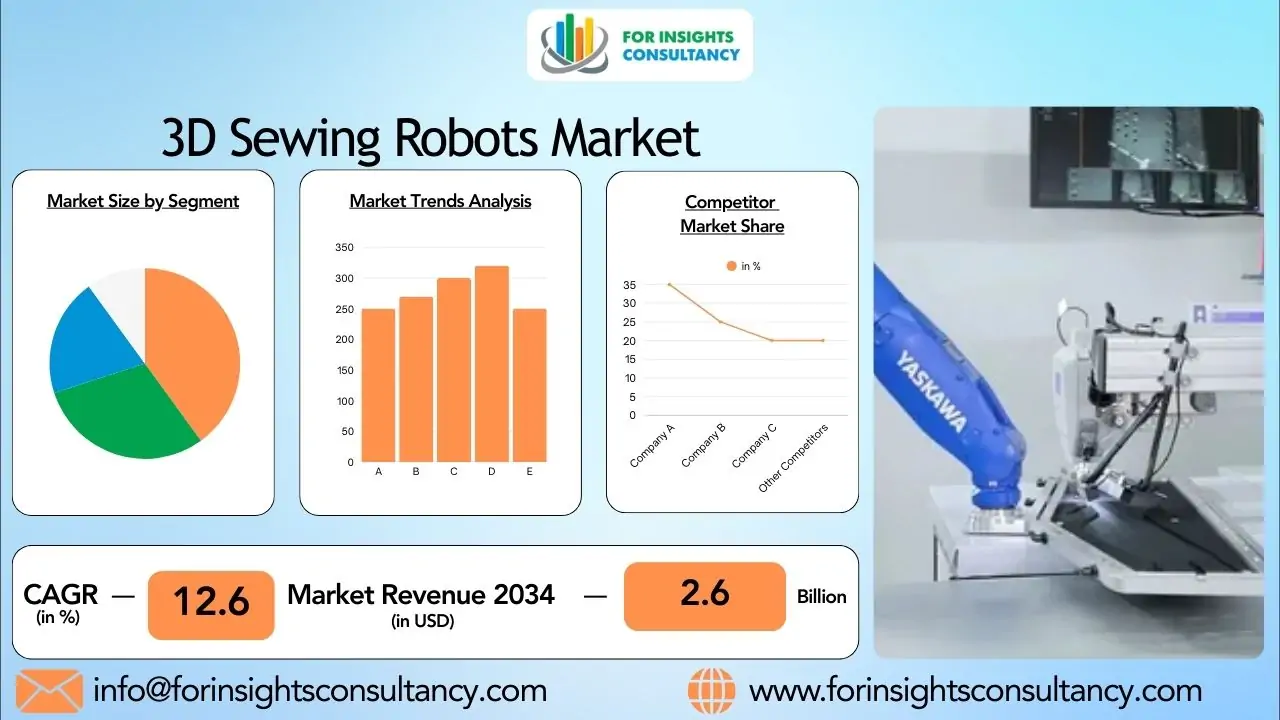
The global 3D sewing robots market is gaining momentum as the textile and apparel industry increasingly adopts automation technologies.

Introduction
The 3D sewing robots market represents an emerging innovation in the textile and apparel manufacturing industry. These advanced robotic systems are designed to automate sewing processes by using 3D vision technology, artificial intelligence, and precision robotics.
Traditionally, sewing has been one of the most labor-intensive processes in garment manufacturing. However, the introduction of 3D sewing robots is helping manufacturers improve efficiency, maintain consistent product quality, and reduce production costs.
By 2026, the adoption of robotic sewing systems is expected to increase as manufacturers seek to modernize production lines and address labor shortages in the textile industry.
Market Overview
The 3D sewing robots market can be segmented based on application, end-use industry, and deployment type.
By Application
- Garment Manufacturing
- Footwear Production
- Automotive Textiles
- Upholstery and Furniture Fabrics
Among these segments, garment manufacturing accounts for the largest share due to the high demand for automated apparel production.
By Deployment Type
- Fully Automated Sewing Systems
- Semi-Automated Robotic Sewing Systems
Fully automated systems are gaining attention as manufacturers aim to reduce manual intervention in production.
By End-Use Industry
- Textile and Apparel Industry
- Automotive Industry
- Furniture Manufacturing
- Industrial Textile Production
The textile and apparel sector remains the primary adopter of 3D sewing robots.
Key Market Drivers
Rising Demand for Automation in Textile Manufacturing
Manufacturers are increasingly adopting automation technologies to improve productivity and reduce operational costs.
Labor Shortages in the Apparel Industry
Many regions face a shortage of skilled sewing workers, encouraging companies to adopt robotic solutions.
Advancements in Robotics and AI
Technologies such as computer vision, machine learning, and robotic precision systems have made automated sewing more feasible.
Growing Focus on Smart Manufacturing
The transition toward Industry 4.0 and smart factories is driving the adoption of robotic manufacturing systems.
Regional Market Insights
North America
North America is witnessing increased adoption of automation technologies in manufacturing industries.
Europe
European textile and automotive industries are exploring robotic sewing solutions to enhance efficiency.
Asia-Pacific
The Asia-Pacific region dominates the textile manufacturing industry and is expected to see significant adoption of sewing automation technologies.
Latin America & Middle East
Emerging manufacturing hubs are gradually integrating automation solutions into their production processes.
Challenges in the 3D Sewing Robots Market
Despite promising growth prospects, the market faces several challenges:
- High initial investment costs for robotic systems
- Technical complexity of sewing flexible fabrics
- Integration challenges with existing manufacturing lines
Manufacturers are addressing these challenges through improved robotics technology and cost-efficient automation solutions.
Future Outlook for the 3D Sewing Robots Market (2026)
The 3D sewing robots market is expected to grow steadily through 2026 as industries continue to adopt automation technologies.
Key Opportunities
- Development of AI-powered robotic sewing systems
- Integration with smart manufacturing and Industry 4.0 technologies
- Expansion into automotive and technical textile production
- Increasing investment in advanced robotics for apparel manufacturing
Companies focusing on innovation, robotics engineering, and industrial automation solutions are expected to gain a competitive advantage in this evolving market.