Asia Pacific Automated Guided Vehicle Market 2026: Demand from Manufacturing and E-commerce
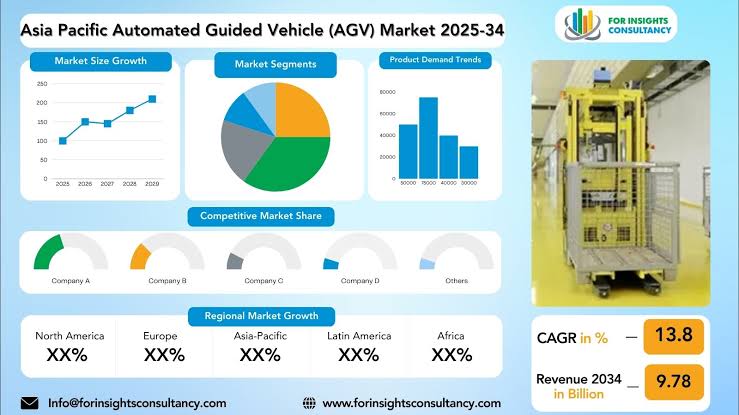
The Asia Pacific Automated Guided Vehicle (AGV) Market in 2026 is witnessing rapid expansion as industries increasingly adopt automation technologies to improve operational efficiency.

Introduction
The Asia Pacific Automated Guided Vehicle Market is expected to experience strong growth in the coming years due to rising demand for automated material handling systems. AGVs are mobile robots designed to transport materials within warehouses, factories, and distribution centers without human intervention.
These systems are widely used across industries such as manufacturing, e-commerce, automotive, food & beverage, and pharmaceuticals.
Key factors driving market growth include:
- Rapid industrial automation across manufacturing sectors
- Expansion of e-commerce and warehouse infrastructure
- Rising labor costs in manufacturing hubs
- Growing demand for efficient supply chain management
- Adoption of smart factories and Industry 4.0 technologies
As businesses seek to optimize logistics operations and reduce operational costs, the adoption of AGVs is increasing significantly across Asia Pacific.
Key Drivers of the Asia Pacific Automated Guided Vehicle Market
Growth of E-commerce and Warehousing
The rise of e-commerce platforms across Asia Pacific has significantly increased the demand for automated warehouse solutions.
Large fulfillment centers require efficient material handling systems to manage high volumes of inventory and shipments. Automated guided vehicles help streamline warehouse operations by transporting goods quickly and accurately.
Increasing Industrial Automation
Manufacturers are increasingly integrating automation technologies to improve production efficiency and reduce operational costs.
AGVs play a vital role in modern manufacturing plants by transporting raw materials, components, and finished goods between different production stages.
Industries adopting AGVs include:
- Automotive manufacturing
- Electronics production
- Food processing
- Pharmaceutical manufacturing
Rising Labor Costs and Workforce Challenges
Many countries in Asia Pacific are experiencing rising labor costs and workforce shortages in manufacturing and logistics sectors.
Automated guided vehicles help companies address these challenges by reducing reliance on manual labor while improving productivity and safety.
Asia Pacific Automated Guided Vehicle Market Segmentation
By Vehicle Type
The market includes several types of AGVs designed for specific applications:
- Tow Vehicles
- Unit Load Carriers
- Forklift AGVs
- Automated Carts
Forklift AGVs are increasingly popular due to their ability to handle heavy loads in warehouse environments.
By Navigation Technology
AGVs rely on different navigation systems to move within facilities:
- Laser Guidance
- Magnetic Guidance
- Vision Guidance
- Natural Navigation
Laser and vision guidance technologies are gaining popularity due to their flexibility and precision.
By End-User Industry
Key industries adopting AGV technology include:
- Automotive
- E-commerce and Retail
- Food & Beverage
- Pharmaceuticals
- Electronics Manufacturing
The automotive sector represents a significant share of the market due to the need for efficient assembly line material handling.
Regional Insights
China
China dominates the Asia Pacific Automated Guided Vehicle Market due to its strong manufacturing sector and rapid adoption of smart factory technologies.
Large investments in automation and logistics infrastructure are driving market expansion.
Japan
Japan is a pioneer in robotics and automation technologies. The country has a strong presence of AGV manufacturers and continues to invest heavily in advanced material handling solutions.
India
India is emerging as a promising market due to growing manufacturing activities, expansion of e-commerce warehouses, and government initiatives promoting industrial automation.
Key Companies in the Asia Pacific AGV Market
Several leading companies are actively competing in the regional market, including:
- Daifuku Co., Ltd.
- Toyota Industries Corporation
- KION Group AG
- Jungheinrich AG
- Murata Machinery Ltd.
- SSI Schaefer Group
- Dematic
- Seegrid Corporation
These companies focus on technological innovation, product development, and strategic partnerships to strengthen their market presence.
Emerging Trends in the Asia Pacific AGV Market
Integration with Smart Warehouses
AGVs are increasingly integrated with warehouse management systems (WMS) and artificial intelligence to enable fully automated logistics operations.
Adoption of Autonomous Mobile Robots
Autonomous mobile robots (AMRs) are gaining traction as they provide greater flexibility compared to traditional AGVs.
Expansion of Industry 4.0
The adoption of Industry 4.0 technologies is accelerating the use of intelligent material handling systems across manufacturing facilities.
Challenges in the Market
Despite strong growth prospects, several challenges affect market adoption:
- High initial investment costs
- Integration complexity with existing infrastructure
- Lack of skilled workforce for automation systems
However, technological advancements and decreasing hardware costs are expected to address these issues over time.
Future Outlook (2026–2032)
The Asia Pacific Automated Guided Vehicle Market is projected to witness rapid expansion as companies continue investing in automation and smart logistics systems.
Future opportunities include:
- Expansion of automated warehouses
- Integration of AI-powered robotics
- Growth in semiconductor and electronics manufacturing
- Increasing demand from e-commerce fulfillment centers
Asia Pacific is expected to remain the fastest-growing region for AGV adoption globally.