Zero Trust Network Access Market 2026: Key Drivers and Technology Trends
The Zero Trust Network Access Market in 2026 is expanding rapidly as organizations worldwide adopt modern cybersecurity strategies to protect networks and sensitive data.

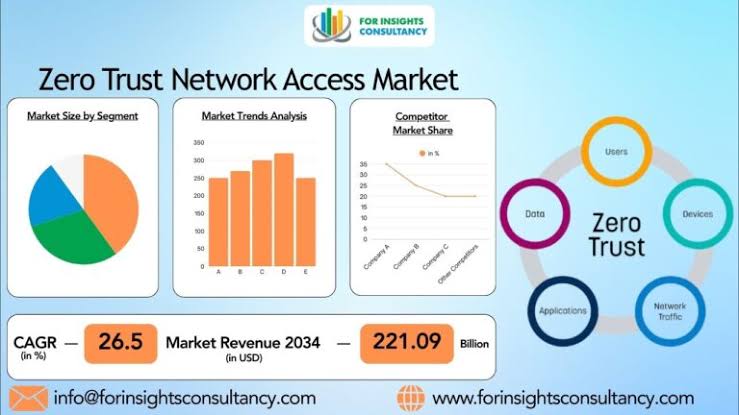
Introduction
The Zero Trust Network Access (ZTNA) Market has gained significant momentum as enterprises transition from traditional perimeter-based security models to modern identity-driven security architectures.
Zero Trust Network Access is based on the principle of “never trust, always verify.” Instead of automatically trusting users inside a corporate network, ZTNA continuously verifies user identities, device security, and application access permissions.
ZTNA solutions help organizations secure access to applications, networks, and data across distributed environments such as cloud platforms, remote offices, and mobile workforces.
Key factors driving the market include:
- Rising cybersecurity threats and ransomware attacks
- Growing adoption of cloud computing infrastructure
- Increasing remote and hybrid work models
- Need for secure digital transformation initiatives
- Regulatory compliance and data protection requirements
As organizations move toward cloud-first strategies, the adoption of zero trust security frameworks is becoming essential.
Key Drivers of the Zero Trust Network Access Market
Increasing Cybersecurity Threats
Cyberattacks such as phishing, ransomware, and data breaches are becoming more frequent and sophisticated. Traditional security solutions often struggle to protect distributed networks.
ZTNA solutions reduce the attack surface by ensuring that only authenticated users and secure devices can access applications.
Rapid Adoption of Cloud Computing
The shift toward cloud-based infrastructure has significantly increased the need for advanced access control systems.
Organizations are deploying ZTNA solutions to secure access to cloud-hosted applications and services without relying on traditional VPN architectures.
Growth of Remote and Hybrid Work
Remote work environments have become a permanent feature for many organizations.
Zero Trust Network Access enables secure connectivity for employees working from different locations while maintaining strict access control policies.
Zero Trust Network Access Market Segmentation
By Component
The ZTNA market includes two primary components:
- Solutions
- Services
Solutions include identity verification, access management, and threat monitoring tools, while services include deployment, integration, and maintenance.
By Deployment Mode
ZTNA solutions are available through different deployment models:
- Cloud-Based Deployment
- On-Premise Deployment
Cloud-based ZTNA solutions are increasingly popular due to scalability, flexibility, and ease of deployment.
By Enterprise Size
Organizations adopting ZTNA solutions include:
- Large Enterprises
- Small and Medium Enterprises (SMEs)
Large enterprises currently represent the largest market share due to their complex IT infrastructures and higher security needs.
By Industry Vertical
ZTNA adoption is increasing across several industries:
- Banking, Financial Services, and Insurance (BFSI)
- Healthcare
- IT and Telecommunications
- Government and Public Sector
- Retail and E-commerce
- Manufacturing
The BFSI sector remains one of the largest adopters due to strict data protection and compliance requirements.
Regional Analysis
North America
North America dominates the Zero Trust Network Access Market due to early adoption of advanced cybersecurity technologies and the presence of major technology companies.
Europe
Europe is witnessing strong growth driven by strict data privacy regulations such as GDPR and increasing investment in cybersecurity infrastructure.
Asia-Pacific
Asia-Pacific is emerging as the fastest-growing region due to rapid digital transformation, expansion of cloud services, and increasing cyber threats.
Key Companies in the Zero Trust Network Access Market
Several major cybersecurity companies are leading innovation in the market:
- Palo Alto Networks
- Cisco Systems
- Zscaler
- Fortinet
- Akamai Technologies
- Cloudflare
- Check Point Software Technologies
- Netskope
These companies are focusing on cloud-native security platforms, AI-driven threat detection, and integrated access management solutions.
Emerging Trends in the ZTNA Market
Integration with SASE Architecture
ZTNA is increasingly integrated into Secure Access Service Edge (SASE) frameworks, which combine networking and security capabilities into a unified platform.
AI and Machine Learning in Cybersecurity
Artificial intelligence is improving threat detection, risk analysis, and automated response mechanisms within zero trust architectures.
Identity-Centric Security Models
Organizations are shifting toward identity-first security approaches where access decisions are based on user identity, device health, and behavioral analytics.
Challenges in the Market
Despite strong growth potential, several challenges exist:
- Complexity in implementing zero trust architecture
- High deployment and integration costs
- Lack of skilled cybersecurity professionals
However, ongoing advancements in cloud security technologies are helping organizations overcome these barriers.
Future Outlook (2026–2032)
The Zero Trust Network Access Market is expected to experience significant growth as enterprises continue to strengthen their cybersecurity strategies.
Future opportunities include:
- Expansion of cloud-native security solutions
- Growth in SME cybersecurity investments
- Increasing adoption of SASE frameworks
- Government initiatives for national cybersecurity infrastructure
As digital ecosystems become more complex, zero trust security models will play a critical role in protecting enterprise networks.